

The top news stories from Asia and the Pacific
Provided by AGP
Australian first: Brisbane corneal surgeons Dr David Gunn and Dr Brendan Cronin offer customised CAIRS for keratoconus
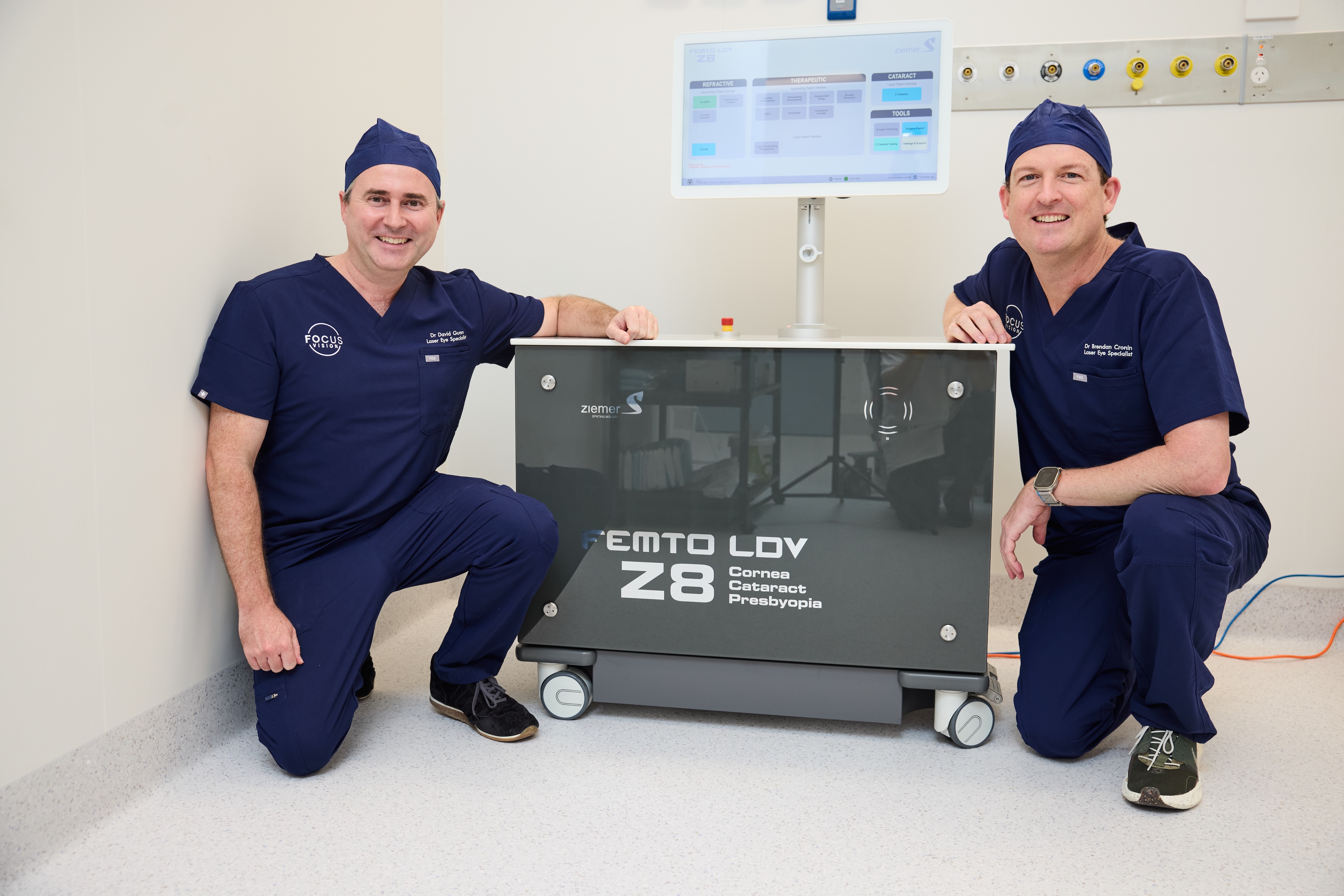
Dr David Gunn and Dr Brendan Cronin crouching next to two Ziemer Z8 femtosecond laser
Brisbane ophthalmologists are the second clinical team in the world to offer laser customised femtosecond CAIRS for keratoconus
BRISBANE, QUEENSLAND, AUSTRALIA, May 8, 2026 /EINPresswire.com/ -- Australian first: Brisbane corneal surgeons Dr David Gunn and Dr Brendan Cronin offer customised femtosecond CAIRS for keratoconus
Brisbane ophthalmologists are the second clinical team in the world — and the first in Australia — to offer customised femtosecond‑laser‑created corneal allogenic intrastromal ring segment (CAIRS) keratoplasty for keratoconus, pellucid marginal degeneration and post‑LASIK ectasia, using the Ziemer Z8 femtosecond laser.
Australian corneal surgeons Dr David Gunn and Dr Brendan Cronin have become the first ophthalmologists in Australia — and the second clinical team worldwide — to offer customised femtosecond‑laser‑created corneal allogenic intrastromal ring segments (CAIRS), a tissue‑additive corneal procedure for the management of keratoconus and other progressive corneal ectatic conditions.
The procedure is performed using the Ziemer Z8 femtosecond laser with the customised CAIRS keratoplasty module, which generates patient‑specific donor‑tissue ring segments and corresponding intrastromal channels in the recipient cornea.
About CAIRS for keratoconus
CAIRS — corneal allogenic intrastromal ring segments — is a tissue‑additive keratoplasty technique in which segments of donor (allogenic) corneal tissue are placed into channels within the recipient cornea to flatten and regularise its shape. It is offered as an alternative to synthetic intracorneal ring segments and, in selected cases, may delay or avoid the need for a full‑thickness corneal transplant.
Conditions for which CAIRS is being offered at the Brisbane practice include:
• Keratoconus
• Pellucid marginal degeneration
• Post‑LASIK ectasia (corneal ectasia following previous laser refractive surgery)
Customised femtosecond delivery with the Ziemer Z8
Where conventional CAIRS techniques rely on manually trephined or standard‑profile ring segments, the customised femtosecond approach uses the Ziemer Z8 platform to cut both the donor segments and the recipient channels to a treatment plan tailored to the individual eye’s topography and ectatic pattern. The intent is to deliver a more reproducible and patient‑specific result than is possible with manual or standardised techniques.
Internationally adopted CAIRS planning platform
Dr Gunn and Dr Cronin are also the developers of cairsplan.com, a clinical planning platform used by corneal surgeons internationally to plan CAIRS procedures from patient corneal imaging. The platform reflects the surgeons’ ongoing involvement in the development and refinement of CAIRS technique and supports surgeons in multiple countries.
About Dr David Gunn and Dr Brendan Cronin
Dr David Gunn and Dr Brendan Cronin are Brisbane‑based ophthalmologists specialising in corneal and refractive surgery, including the surgical management of keratoconus, corneal ectasia and corneal transplantation. Both are Fellows of the Royal Australian and New Zealand College of Ophthalmologists (FRANZCO) and registered with the Medical Board of Australia under the Australian Health Practitioner Regulation Agency (AHPRA). Further information about each surgeon’s training, areas of subspecialty interest and clinical work is available at drdavidgunn.com.au and drbrendancronin.com.au.
Why this matters for Australian patients with keratoconus
Keratoconus is a progressive corneal condition that typically presents in adolescence or early adulthood and is the most common corneal ectatic disorder in Australia. Treatment options have traditionally ranged from rigid contact lenses and corneal cross‑linking through to synthetic intracorneal ring segments and, in advanced cases, corneal transplantation. The introduction of customised femtosecond CAIRS expands the range of tissue‑additive options available to Australian patients and provides a domestic option for patients who would otherwise need to consider treatment overseas.
Important information
Any surgical or invasive procedure carries risks. Suitability for customised femtosecond CAIRS is determined on a case‑by‑case basis following a comprehensive corneal assessment, and not all patients with keratoconus, pellucid marginal degeneration or post‑LASIK ectasia will be suitable candidates. Outcomes vary between individuals and cannot be guaranteed. Patients are encouraged to seek a second opinion from an appropriately qualified health practitioner before proceeding with any surgical treatment.
Dr Brendan Cronin
Queensland Eye Institite
email us here
Legal Disclaimer:
EIN Presswire provides this news content "as is" without warranty of any kind. We do not accept any responsibility or liability for the accuracy, content, images, videos, licenses, completeness, legality, or reliability of the information contained in this article. If you have any complaints or copyright issues related to this article, kindly contact the author above.
