

Pervaziv AI Debuts Cortex Router as the Eighth Model in Its Specialized AI Ensemble
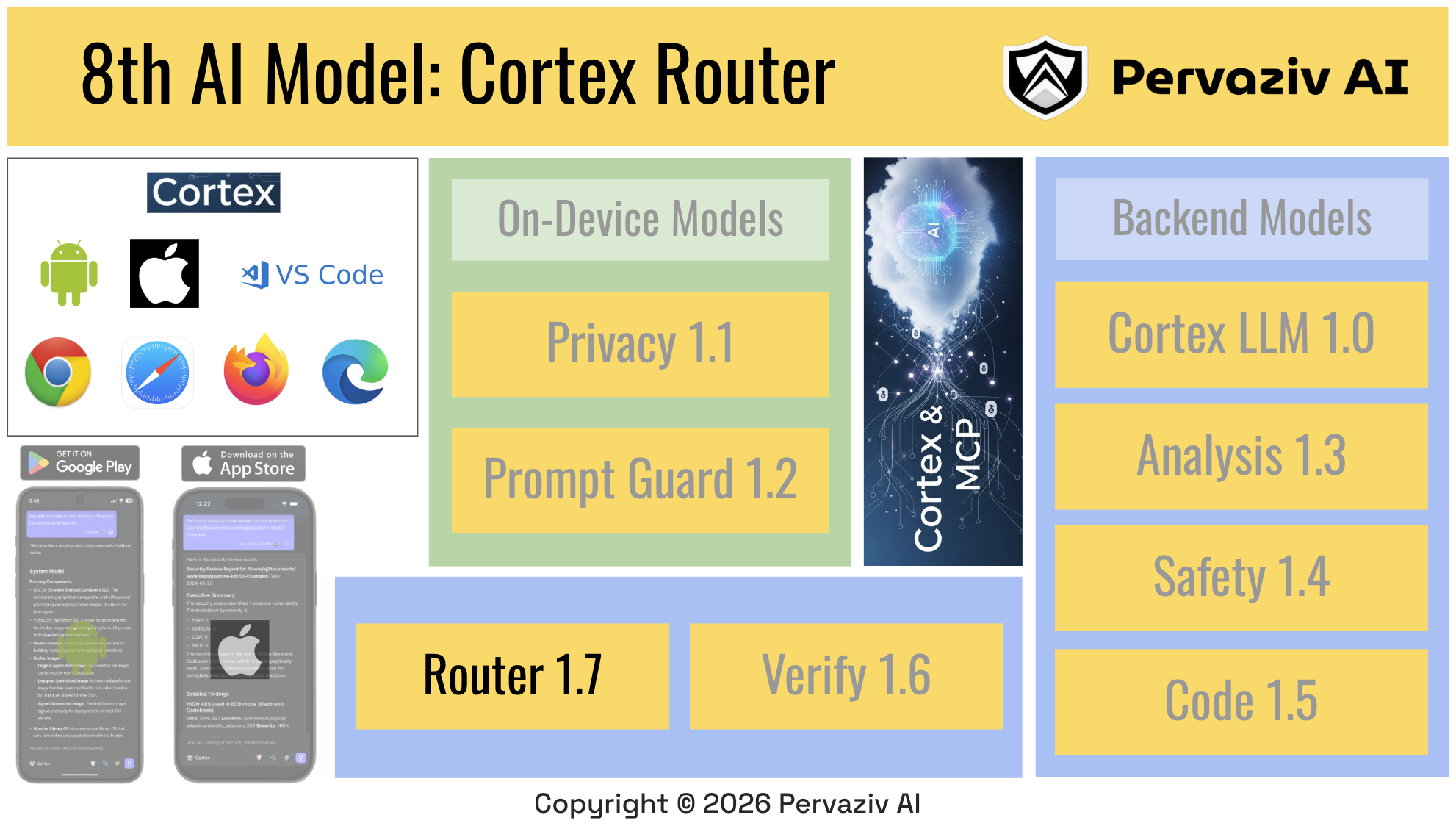
Cortex Router for AI Model Ensemble

Purpose-trained model understands developer intent and coordinates coding, security, safety, privacy, prompt protection, analysis, and verification workflows.
SAN FRANCISCO , CA, UNITED STATES, August 7, 2026 /EINPresswire.com/ -- Pervaziv AI today announced Cortex Router, the eighth specialized AI model in the Cortex AI Model Ensemble. Purpose-trained for intelligent task routing and workflow coordination, Cortex Router helps identify the type of work a developer is requesting and guides it toward the most appropriate specialized model, engineering workflow, or level of human oversight.
The release marks the next stage in Pervaziv AI’s specialized model strategy. Cortex 5.2 introduced an AI Model Ensemble built around the principle that modern software development should not be handled as one undifferentiated task. Cortex Verify later became the seventh specialized model, extending the architecture with AI-assisted code and patch validation.
Cortex Router now expands the ensemble to eight specialized models.
Unlike the seven models it coordinates, Cortex Router is trained specifically to understand developer intent, classify requests, evaluate task scope and risk, and determine the appropriate next path through Cortex. It serves both as a specialized routing model and as the coordinating entry point for the wider ensemble.
The release is designed to make Cortex feel less like a catalog of separate AI models and more like a connected engineering environment. Developers can state what they need in familiar language and reach the appropriate form of assistance without first learning the boundaries between models, workflows, tools, or operating modes.
## Executive Commentary
-----------------------------------
“Enterprises do not need another model menu that developers must learn and manage,” said Anoop Jaishankar, Founder and CEO of Pervaziv AI. “They need an intelligent control layer that understands the difference between a quick question, a complex engineering task, a security-sensitive workflow, and a consequential action. Cortex Router is our eighth specialized model, trained to turn developer intent into the right path across Cortex. Developers can focus on the outcome while Cortex coordinates the appropriate intelligence, safeguards, and level of human involvement.”
Jaishankar continued, “The future of Enterprise AI is not one general model for every interaction, but specialized intelligence coordinated around developer intent, task risk, and the right level of human oversight. Cortex Router gives that system an intelligent starting point. It helps determine what kind of work is being requested, which capability should participate, and how carefully the next action should be handled. That is how organizations can increase development velocity without making security, governance, or accountability an afterthought.”
## The Eighth Specialized Model in the Cortex Ensemble
---------------------------------------------------------------------------
The addition of Cortex Router expands the Cortex AI Model Ensemble from seven to eight specialized models.
The ensemble includes focused AI capabilities supporting privacy-aware preflight checks, prompt injection defense, secure development, structured security analysis, safety-aware decisioning, broad coding assistance, code verification, and now intelligent task routing and coordination.
Each model is designed around a distinct operational responsibility.
Privacy-focused capabilities can help identify sensitive developer and enterprise context before it is sent to broader AI services. Prompt security can inspect untrusted content for instruction manipulation and prompt injection risk. Secure development and security analysis models can support vulnerability detection, understanding, prioritization, and remediation. Safety-aware decisioning can identify elevated risk and help determine when additional restrictions, validation, or human review may be appropriate.
Broad coding capabilities can support implementation, debugging, explanation, refactoring, and planning. Cortex Verify can help assess code and patch changes so teams can build greater confidence before software advances through the development lifecycle.
Cortex Router adds a different form of specialization. It is trained to understand the request that arrives before the other models begin their work.
Its role is to determine whether a user needs a direct answer, a coding workflow, a security-focused investigation, a verification step, broader analysis, or additional confirmation before an action proceeds. This makes Cortex Router both the eighth member of the ensemble and the model responsible for helping coordinate access to the other seven.
## A Unified Starting Point for AI-Assisted Development
---------------------------------------------------------------------------
AI-assisted development is moving beyond isolated chat interactions. A developer may begin with a quick repository question, discover a defect that requires investigation, request a code change, ask for a security review, and then need confidence that the resulting change is ready for release.
The user experience should remain continuous, but the work itself is not one kind of task.
A request to identify a file owner is different from a multi-file implementation. A dependency question is different from a vulnerability remediation. A routine lookup is different from an action that can affect production systems, customer data, source code, or software delivery.
Cortex Router is designed to recognize these differences and help select an appropriate next step.
Routine interactions can remain lightweight. Larger engineering efforts can enter a more complete development workflow. Security-focused requests can reach specialized analysis or remediation models. Verification-oriented work can connect with Cortex Verify. Requests with meaningful consequences can receive the appropriate safeguards, confirmation, or human involvement.
The result is a common intelligent entry point for the expanding Cortex platform, with specialization available behind the experience rather than imposed on the user.
## Why a Purpose-Trained Routing Model Matters
-------------------------------------------------------------------
The most visible AI development question is often which model produces the best answer. For enterprises, an equally important operational question is which model should receive the request and what should happen next.
Software teams work across code generation, debugging, repository understanding, architecture analysis, security assessment, remediation, validation, documentation, planning, and deployment. These activities differ in context requirements, risk, expected output, required tools, and the level of review appropriate before an action proceeds.
Sending every request through the same model and workflow can create unnecessary latency, inconsistent behavior, excessive context use, unclear accountability, and an unpredictable developer experience. It can also reduce the value of specialization because users are required to understand when and how to invoke each capability.
A traditional rules-based router can identify simple categories, but engineering work is often more nuanced. A short prompt may imply a broad change. A request that appears informational may contain security implications. A coding task may require verification after implementation. A routine action may become consequential depending on the system, repository, permissions, or context involved.
New model helps Cortex recognize the intent behind the request, understand the type of engineering work involved, and guide the task toward an appropriate specialized model or workflow. It can also help identify when the user should remain more closely involved before an action continues.
## From Seven Execution Models to an Eight-Model Coordinated System
------------------------------------------------------------------------------------------------
The Cortex AI Model Ensemble is based on a simple product principle: software development is diverse, and AI should be specialized where specialization improves performance, privacy, security, safety, or confidence.
Cortex Router strengthens that approach by making specialization easier to use.
Instead of asking developers to select a model before asking a question, Cortex can use the request and available context to guide the work toward the capability designed for it. The user begins with the desired outcome, while Cortex Router helps determine the appropriate route.
This does not remove user control. The purpose of routing is to make the next step clearer and more proportional while preserving transparency, authorization boundaries, organizational policies, and human intent.
That distinction enables Cortex to operate as a more integrated system. The seven existing models can remain focused on the work they were designed to perform, while Cortex Router specializes in deciding how each request should enter that system.
## Extending the Cortex Verify Story
-------------------------------------------------
Cortex Verify reinforced a central reality of software delivery: generating or modifying code is only part of the job. Teams also need to validate changes, examine evidence, and build confidence before software advances toward production.
Cortex Router complements that release by helping identify verification needs earlier in the workflow.
A developer may begin with an implementation request, continue through a code change, and then require validation. A security team may start with a reported issue, move through remediation, and need evidence that the vulnerability has been addressed without introducing regressions. A reviewer may need a structured understanding of the resulting change before approval.
Rather than treating these moments as disconnected product steps, Cortex Router helps create a more natural path from developer intent to implementation, review, security analysis, and verification.
When a request requires code validation, Cortex Router can guide the work toward Cortex Verify. When it requires a security-focused investigation or remediation workflow, it can direct the request toward the appropriate security model. When the task is broader or more analytical, the router can select a different path.
Together, the eight-model ensemble, Cortex Verify, and Cortex Router represent a broader vision for secure agentic engineering. The objective is not only to generate an answer or patch. It is to coordinate the sequence of specialized capabilities required to move from an initial request toward a more reliable outcome.
## Designed Around the Natural Rhythm of Developer Work
--------------------------------------------------------------------------------
Software development rarely follows a fixed sequence. Developers move constantly between quick questions and deeper work.
A routine interaction may involve locating information in a repository, understanding project structure, inspecting a result, or checking the status of a component. A deeper task may require investigating behavior across several files, designing a feature, changing code, assessing security impact, or continuing an existing engineering effort.
Cortex Router helps distinguish these moments.
Simple requests can remain simple rather than entering an unnecessarily heavy workflow. Broader tasks can receive the context, planning, tools, and structured execution they require. Security requests can be treated with the attention appropriate to their impact. Consequential actions can remain tied to explicit user intent and applicable controls.
This proportional behavior is important to developer trust. An AI system should be quick when the request is routine, deliberate when the task is complex, and appropriately cautious when the outcome carries greater risk.
Cortex Router is designed to support that balance without requiring developers to classify every request themselves.
## Less Friction and More Governed Velocity
-----------------------------------------------------------
For organizations scaling AI-assisted development, the opportunity is not limited to helping an individual developer complete a task faster. The larger opportunity is to create repeatable ways for teams to move faster together.
Cortex Router supports that goal through several business benefits.
A more unified developer experience allows teams to begin from a common intelligent entry point rather than navigate a growing collection of disconnected AI tools and model choices.
Better use of specialized capabilities helps organizations align each request with the type of intelligence and workflow it requires.
More appropriate handling of sensitive work allows security remediation, code review, validation, and consequential actions to be treated differently from ordinary information requests.
Reduced workflow disruption helps developers stay close to their repositories, development tools, and active work rather than repeatedly changing surfaces or manually transferring context.
A scalable model architecture means the Cortex ensemble can continue adding specialized value without becoming harder for developers to learn and use.
This distinction is critical for enterprise adoption. AI programs are not sustained by one-time demonstrations. They are sustained by workflows developers use repeatedly, leaders can understand, security teams can evaluate, and organizations can evolve with confidence.
## Responsible Autonomy, Not Automation Without Boundaries
--------------------------------------------------------------------------------------
The conversation around AI agents is often framed as a choice between full automation and manual control. In real engineering environments, the more useful question is how autonomy should change according to the task, context, authorization, and potential impact.
Cortex Router supports a practical approach to responsible autonomy. It can help identify when a request is routine, when it should become a broader workflow, when another specialized model should be involved, and when a user should remain closely engaged in the decision.
A repository lookup should not require the same process as vulnerability remediation. A broad implementation request should not be handled like a simple question. A consequential operational action should not be hidden behind an opaque handoff.
Cortex is designed to help people work with AI while preserving accountability. The eighth specialized model supports that goal by making the transition from request to action more deliberate and by helping apply the right intelligence and controls at the appropriate stage.
## Built for Engineering Workflows
-----------------------------------------------
Cortex Router is trained around the distinctions that appear in real software engineering work. Development consists of questions, decisions, investigations, changes, reviews, validation, and handoffs. Context changes quickly, and the appropriate form of AI assistance can change with it.
The router supports developers where work begins and helps Cortex remain useful as the nature of that work evolves.
This workflow-first approach does not require teams to replace the development systems they trust. It is intended to make the AI layer more responsive to the work happening across those systems while providing a clearer path into the wider Cortex AI Model Ensemble.
For platform and engineering leaders, this creates a more coherent adoption story. Organizations can introduce one Cortex experience rather than require users to memorize an expanding model catalog. As specialized capabilities grow, the intelligent entry point can remain consistent.
## An Intelligent Coordination Model for the Enterprise AI Control Layer
-----------------------------------------------------------------------------------------------
Cortex Router advances Pervaziv AI’s broader vision for Cortex as an Enterprise AI Control Layer.
Enterprise AI requires more than access to powerful models. Organizations need to manage what context is used, where it goes, which models participate, what safeguards are applied, how actions are authorized, when validation is required, and how humans remain accountable for outcomes.
The Cortex AI Model Ensemble provides specialized intelligence across those responsibilities. Cortex Router is the specialized model trained to coordinate how that intelligence is reached from the developer experience.
This architecture also extends Pervaziv AI’s model independence strategy. Model independence is not simply the ability to select among providers. It is the ability to design a system in which models can be evaluated, routed, improved, replaced, and governed according to a defined role.
By separating model responsibilities and coordinating them through Cortex Router, Pervaziv AI can continue evolving individual capabilities without requiring the entire developer experience to be redesigned around every model change.
## Summary of What Is New in Cortex Router
------------------------------------------------------------
The model is trained specifically to support the development entry experience by interpreting developer intent, classifying the requested work, evaluating its scope and sensitivity, and selecting the appropriate model, workflow, or next action.
It supports transitions between routine interactions and broader development work, including coding tasks, analysis, security-focused requests, safety-relevant decisions, and verification-oriented workflows.
The emphasis is intelligent coordination, not complication. The most effective routing model is one that helps users reach the right next step without becoming another system they must manually manage.
## Looking Ahead
-------------------------
Pervaziv AI plans to continue expanding the Cortex AI Model Ensemble where specialized capabilities create clear value for software teams.
Adding models is only one part of that product direction. The other part is ensuring those models operate together in a way that feels coherent, governable, and useful from the first request.
Pervaziv AI’s direction remains consistent: help organizations adopt AI in software development with greater speed, stronger confidence, and less operational friction while preserving privacy, security, governance, traceability, and human intent.
Pervaziv AI
Pervaziv AI
email us here
Visit us on social media:
LinkedIn
Instagram
YouTube
X
Other
Legal Disclaimer:
EIN Presswire provides this news content "as is" without warranty of any kind. We do not accept any responsibility or liability for the accuracy, content, images, videos, licenses, completeness, legality, or reliability of the information contained in this article. If you have any complaints or copyright issues related to this article, kindly contact the author above.
